Read more about our newly funded study on Gut Health and Menstrual Cycles!
Menopause and Inflammatory Bowel Disease: A Systematic Review
Summary written by Tanvi Kale
In this study, we comprehensively reviewed existing research on how menopause and hormone therapy relate to inflammatory bowel disease (IBD). Out of more than 1600 records, only 15 studies met our criteria, highlighting how limited the evidence is. From these studies, we found that women with IBD tend to experience menopause earlier than women without IBD. Most women did not report major changes in their IBD symptoms after menopause, although a smaller group did experience worsening symptoms. Findings on hormone therapy were inconsistent – some studies suggested an increased risk of ulcerative colitis, while others found no significant association after adjusting for other factors. A few studies indicated that hormone therapy might reduce the severity of IBD flares. We also saw that women with IBD reported more severe vulvovaginal symptoms and had different vaginal microbiome profiles compared to healthy women. Overall, our review shows that there is very little high-quality research on menopause in women with IBD, and the existing findings are mixed and inconclusive. More rigorous studies are needed to better understand how menopause and hormone therapy affect IBD activity and symptoms, so that care for women with IBD can be better tailored across their lifespan.
Link to article: https://pubmed.ncbi.nlm.nih.gov/41032035/
Gender and Sex Differences in Abdominal Pain, Fatigue, And Psychological Symptoms Among Adults with Inflammatory Bowel Disease: A Network Analysis
Background and Context
Research considering the impact of sex and gender on symptoms in inflammatory bowel disease (IBD) has been limited.
New Findings
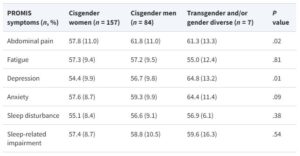
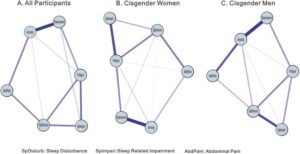
Transgender and gender-diverse individuals with IBD report high abdominal pain and depression levels. Fatigue was the core symptom for cisgender women and anxiety was the core symptom for cisgender men.
Limitations
The sample was recruited online and the majority of participants had active disease as measured by validated instruments.
Clinical Research Relevance
Fatigue and anxiety may serve as important intervention targets for those with IBD. Future studies should evaluate the impact of sex and/or gender differences.
Basic Research Relevance
The underlying mechanisms regarding symptoms of fatigue and anxiety remain to be explored within the IBD population.
Link to article: https://academic.oup.com/ibdjournal/article/31/2/442/7923278